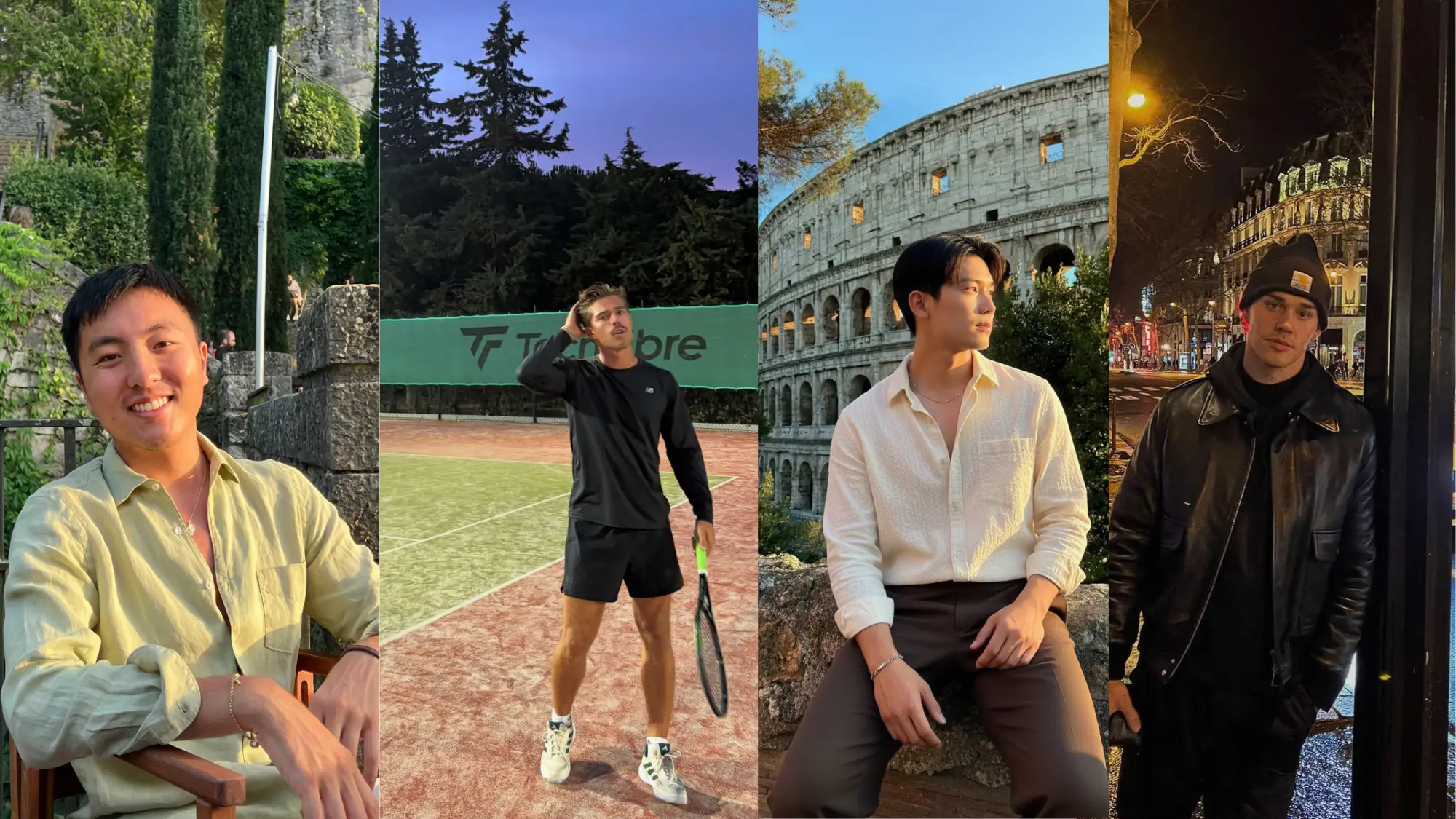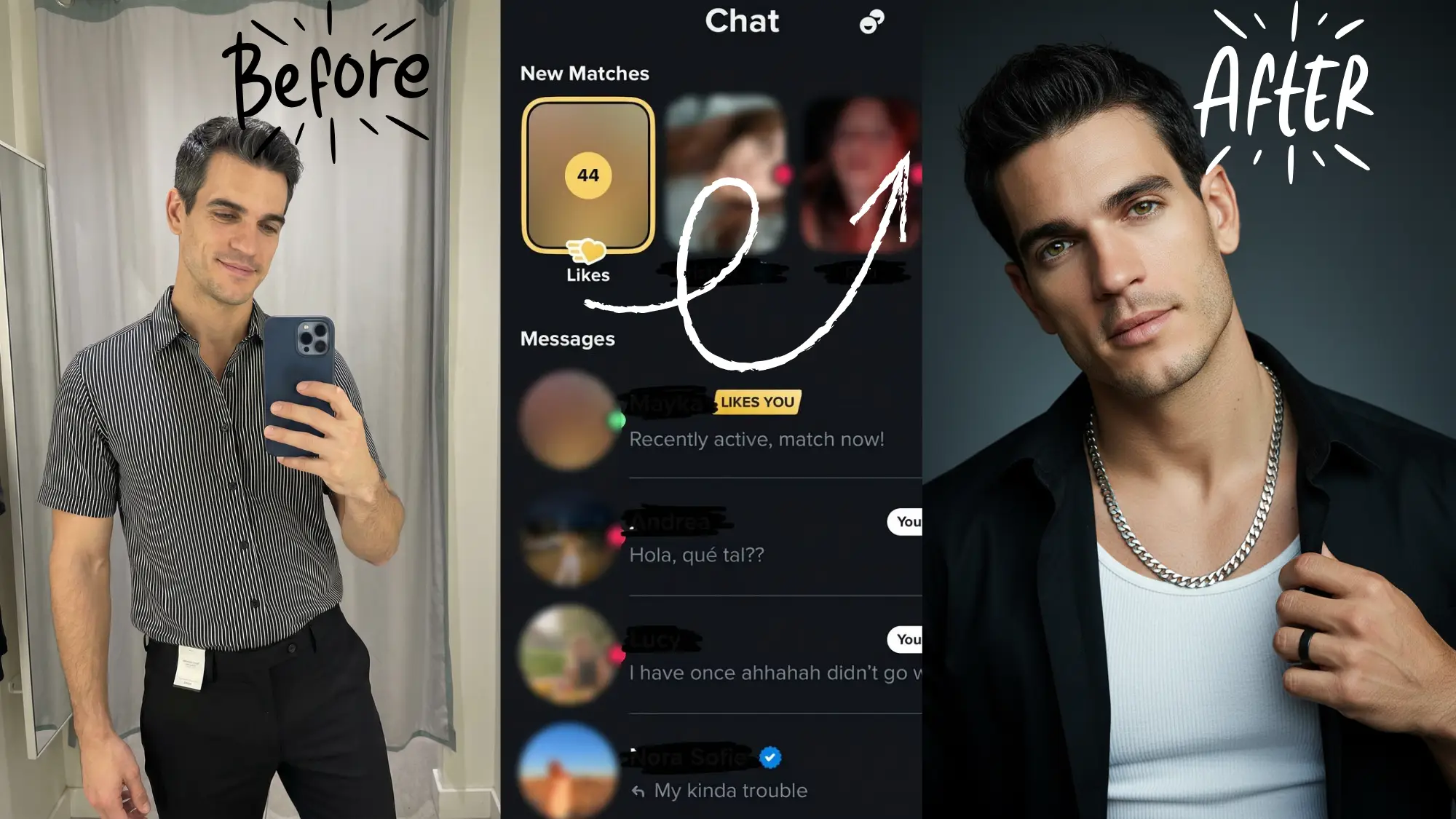

📌 TL;DR: Yes, AI photos are allowed on Tinder, Hinge, and Bumble. None of the three bans AI-generated images outright. What all three ban is misrepresentation, so your photos have to look enough like you to pass face verification. The safe line: use AI to upgrade lighting, setting, and wardrobe, never to change your face, body, or age.
In this guide:
- The Short Answer: Yes, With One Condition
- Are AI Photos Allowed on Tinder?
- Are AI Photos Allowed on Hinge?
- Are AI Photos Allowed on Bumble?
- What Gets an AI Photo Banned vs. What Passes
- Which AI Photo Generators Actually Pass Dating App Verification
- Frequently Asked Questions
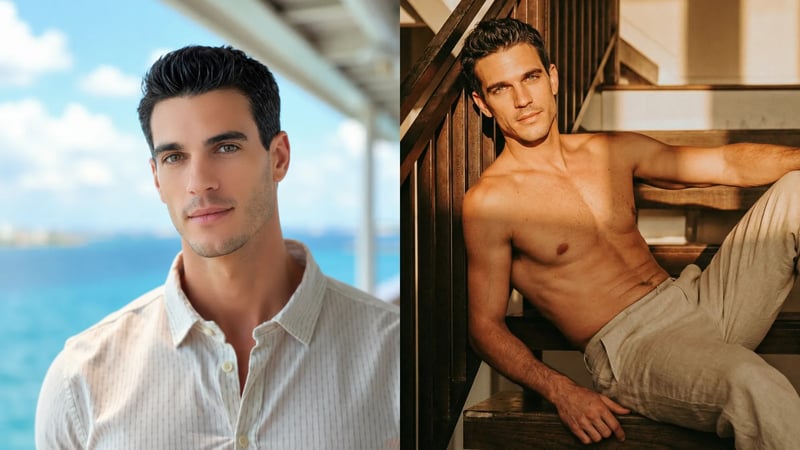
You've spent twenty minutes staring at a TruShot-generated photo that honestly looks better than anything you've taken in the last three years. The lighting is clean, you're smiling the right way, and for once your jawline cooperates. Then the thought hits: is this even allowed?
It's the question I get more than almost any other. After twelve years consulting on dating profiles and working with 1,200+ clients, I'd say about half the guys who try AI photos hesitate right before uploading because they're not sure if they'll get banned.
Here's the direct answer: AI photos are allowed on Tinder, Hinge, and Bumble as of 2026. All three platforms permit AI-generated images as long as the photos accurately represent who you are. The policies don't ban the technology. They ban deception. That's a meaningful distinction, and it changes everything about how you think about using AI dating photos.
The catch is Face Check verification, which rolled out across the U.S. on Tinder in late 2025 and is no longer Tinder-only. According to Match Group's official announcement, Face Check has already cut exposure to bad actors by over 60% on Tinder. In February 2026, Match Group extended the same biometric technology to Hinge, so the same face-matching test now applies there too. Your AI photos need to pass that test. If they match your real face, you're good. If they don't, you won't be.
See how TruShot AI photos pass face verification every time →
The Short Answer: Yes, With One Condition
AI photos are allowed on dating apps when they are trained on your actual face and represent your real appearance accurately enough that a match would recognize you in person.
That's the line. Not "are these AI generated?" but "do these look like the real you?"
Definition: AI dating photos are profile images generated by an AI model trained on a user's own face photos. They are distinct from stock AI faces or AI images of strangers. When generated accurately, they show the real user in better lighting, better settings, and more flattering angles, without altering identity.
None of the major platforms (Tinder, Hinge, or Bumble) have a rule that says "no AI photos." Their rules say no misrepresentation. That framing matters because it means you can use AI photos legally and ethically, provided the AI was trained on your own face and the results actually look like you.
The platforms that ban AI photos wholesale are reacting to catfishing: people using AI to present as someone they're not entirely. That's not what tools like TruShot do. What passes verification is an AI photo that makes you look like the best version of yourself, not a different person.
Key finding: All three major platforms (Tinder, Hinge, and Bumble) prohibit deception in their published community guidelines, not AI photo technology itself. None contain an explicit ban on AI-generated images.
Key takeaway: All three major dating apps allow AI photos under the same condition: the photos must accurately represent who you are. The technology isn't banned. The deception is.
Are AI Photos Allowed on Tinder?
Tinder's Official Policy on AI Photos
Tinder's Community Guidelines don't use the phrase "AI photos." What they say is that you can't misrepresent yourself through your photos, including using images that don't look like you. The practical implication is clear: an AI photo of your own face, in a flattering setting, is fine. An AI photo that makes you look like a different person is not.
Tinder's terms specifically prohibit posting "misleading information" or "inaccurate" content. The test isn't what tool you used to make the photo. The test is whether the photo accurately represents you.
Does Tinder Detect AI Photos?
Tinder doesn't run a simple "AI image detector" that flags every upload for being machine-generated. What Tinder does run is Face Check, which is a significantly harder test to game.
Face Check compares your uploaded profile photos against a live video selfie. It checks whether the face in your photos matches the face doing the selfie, in real time, with liveness detection. It also creates an encrypted face map to catch duplicate accounts.
What this means practically: Tinder isn't asking "was this photo AI generated?" It's asking "does this photo match your real face?" If your AI photos were generated from your own selfies, the answer is yes. If they were generated using someone else's face or altered your appearance significantly, the answer is no and your account will be flagged.
Why Your Tinder Selfie Is Under Review
If you've seen the "your selfie is under review" message on Tinder, you've hit the Face Check queue. Most selfie reviews resolve in 5 to 30 minutes through automated processing. If the system detects something that needs a second look, the review can extend to 24 to 48 hours. A small number of cases get escalated to manual human review and can take several days.
What triggers an extended review:
- Profile photos that don't closely match your current appearance
- Poor lighting or shaky video in your verification selfie
- Sunglasses, hats, or filters in your uploaded photos (the system can't extract facial geometry from accessories)
- VPN usage during the verification step
- Technical mismatches between photos that suggest inconsistency
How long does a Tinder selfie review take? Most pass in under 30 minutes. If yours has been sitting for more than 48 hours without resolution, submit a ticket through Tinder's Help Center.
The key insight here is what makes a verification fail. It's almost never "this is an AI photo." It's "this face doesn't match this selfie." That's a solvable problem if your AI photos were built from your real face.
What Makes AI Tinder Photos Pass Face Check
AI photos that pass Tinder's Face Check share a few characteristics. They show your actual face structure without significant alteration to your jawline, nose, eye shape, or skin tone. They use natural lighting rather than dramatic stylized filters. They don't obscure your face with accessories. And they were generated from a diverse set of input photos so the AI has an accurate model of your actual face to work from.
The AI Tinder photos TruShot generates are trained on 10 to 20 of your real selfies, which gives the model enough data to reproduce your genuine facial geometry. That's why Face Check passes: the AI photo and your live selfie are showing the same person.
One user described it this way:
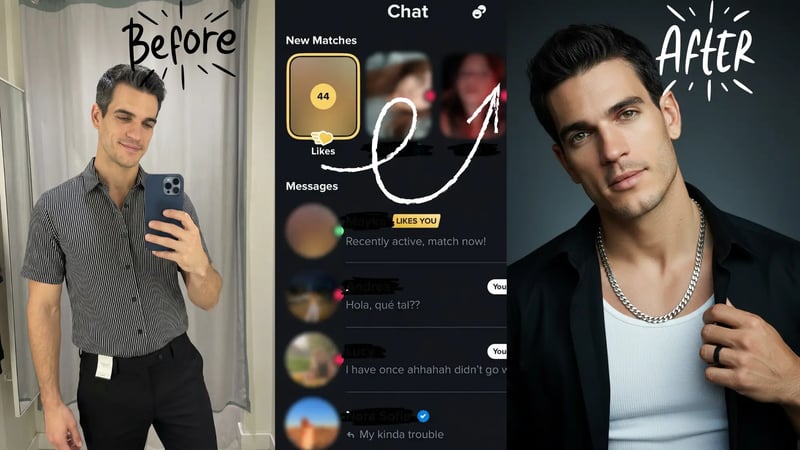
"The face verification worked instantly on Tinder, which was my biggest worry. Since swapping my profile to the TruShot-generated ones, the conversation quality has gone way up. Girls are actually messaging me first."
Key finding: Match Group's official data shows Face Check has reduced exposure to bad actors by over 60% since rollout. The system tests face identity through live selfie comparison, not AI image detection.
Key takeaway: Tinder's Face Check tests identity, not AI origin. AI photos that preserve your real facial geometry pass automatically. The only photos that fail are those that altered your appearance enough to create a mismatch.
Are AI Photos Allowed on Hinge?
Hinge's Official Policy on AI Photos
Hinge's Community Guidelines state that users should not "use fake identities or AI-generated content to mislead others." That's the operative phrase: to mislead others. The policy targets deception, not the technology itself.
Hinge requires at least one photo that clearly shows your face. It prohibits misleading or outdated photos and says that content shared should be "real, personal, and current." An AI photo trained on your real face, showing a flattering but accurate version of you, clears that bar.
Does Hinge Detect AI Photos?
That question had a different answer earlier in 2026. Hinge now runs its own Face Check. On February 5, 2026, Match Group extended the same FaceTec liveness technology behind Tinder's system to Hinge, according to Biometric Update. It's mandatory in the U.S., U.K., and Australia, and completing it gets you a "Selfie Verified" badge on your profile.
Hinge frames the requirement partly as age verification rather than pure fraud prevention, but the mechanism is identical to Tinder's: a live video selfie compared against your uploaded profile photos. Hinge's own AI Principles confirm generative AI images are allowed on profiles as long as they don't misrepresent you, which is the same authenticity bar the Face Check scan enforces technically.
Outside the Face Check flow, Hinge can still remove photos and suspend accounts for authenticity violations, and users can report profiles they suspect are using deceptive content. AI photos that look like a better-lit, better-framed version of you pass. AI photos where you look like a completely different person don't.
What Makes AI Hinge Photos Pass Hinge Verification
Hinge's verification now runs on the same underlying biometric technology as Tinder's, so the standard is effectively identical: your AI photos need to show your real face closely enough to match a live selfie scan, not just look plausible to a human reviewer. You don't want dramatic style filters, heavy skin-smoothing that makes you look plastic, or background scenarios that imply a lifestyle dramatically different from reality.
TruShot's AI Hinge photos are calibrated to produce natural-looking output rather than cinematic over-editing. The goal is to look like you had a great photographer, not a CGI budget.
"I uploaded the TruShot App pics to Hinge on Friday night and woke up to 25+ likes. I usually get maybe 1 or 2 a week. The lighting looks so professional, my friends actually asked who took them."
That reaction, "who took these?" rather than "are these real?", is exactly what you're going for.
Key finding: Hinge rolled out its own Face Check in February 2026, using the same FaceTec liveness technology as Tinder, and made it mandatory in the U.S., U.K., and Australia. Profile review outside that flow is still behavior and report-based.
Key takeaway: Hinge's authenticity policy prohibits AI content used to deceive, not AI content used honestly. With Face Check now live on Hinge too, the test is the same as Tinder's: does your AI photo match your real face closely enough to pass a live selfie scan.
Are AI Photos Allowed on Bumble?
Bumble's Official Policy on AI Photos
Bumble has the most explicit AI-specific policy of the three platforms. In 2024, Bumble added a dedicated reporting option for users to flag profiles they suspect of using AI-generated photos. Risa Stein, Bumble's VP of Product, stated: "An essential part of creating a space to build meaningful connections is removing any element that is misleading or dangerous."
Bumble's guidelines prohibit impersonation and misrepresentation, including "artificially generated or enhanced photos used to deceive others." The focus is on deception, not AI use itself.
Bumble worked with the Partnership on AI's Synthetic Media Framework to develop its approach to synthetic content. That framework explicitly balances "identifying synthetic media used to create fake profiles while allowing individuals' creative use of generative AI within authentic profiles." That's a meaningful policy nuance. Bumble's own framework makes room for AI photos used authentically.
Does Bumble Detect AI Photos?
Bumble runs photo verification through a pose-based selfie check. To get verified, you take a selfie mimicking a specific pose randomly selected from about 100 examples. The system compares that selfie to your profile photos.
Bumble also uses a proprietary "Deception Detector" AI tool, launched in 2024, that achieved a 45% reduction in member reports of spam and fake profiles since rollout. Their Anti-Spam team continuously analyzes photo authenticity and behavioral patterns.
The practical takeaway: Bumble's detection is aimed at fake personas using strangers' faces or stock AI images, not real users who used AI to improve their own photos.
Bumble isn't only policing AI on the input side, either. In February 2026, the company launched its own AI-powered profile guidance tools, including a photo feedback feature for U.S. users that reviews your uploaded photos and suggests improvements like better variety or lighting, per Dataconomy. A platform building its own AI tools to help you pick better photos isn't one that treats AI-assisted photos as inherently suspicious. It's the fake ones it's after.
TruShot's AI Bumble photos are built to pass that pose check because they're generated from your real face. The selfie you take for verification and the AI photos on your profile are showing the same person.
Key finding: Bumble's Deception Detector achieved a 45% reduction in member reports of spam and fake profiles since its 2024 launch. The system targets synthetic personas using strangers' faces, not AI photos of real users.
Key takeaway: Bumble's Deception Detector targets fake personas, not AI photos of real people. Its own policy framework, developed with the Partnership on AI, explicitly allows "creative use of generative AI within authentic profiles."
What Gets an AI Photo Banned vs. What Passes
This is the table I wish existed when I started working with AI photos. Research on visual deception in dating contexts confirms that dating app users can detect misrepresentation when the gap between a profile photo and reality is large, but minor improvements in lighting and presentation are both acceptable and expected.
| Factor | Gets Banned or Flagged | Passes Verification |
|---|---|---|
| Face identity | Different person's face | Your real face, better lit |
| Face structure | Altered jawline, nose, or eye shape | Same bone structure as your selfies |
| Skin tone | Significantly lightened or altered | Natural tone with better lighting |
| Age | Made to look 10+ years younger | Natural, current appearance |
| Body/build | Substantially different physique | Same build as your real self |
| Style filters | Heavy artistic or cinematic filters | Clean, natural photography style |
| Background | Misleading lifestyle (yacht, mansion) | Neutral or realistic settings |
| Accessories in photos | Sunglasses covering eyes, heavy hat | Clear view of full face |
| Input source | Scraped from someone else's photos | 10-20 of your own real selfies |
| Likeness consistency | Photos that don't look like each other | Consistent appearance across all photos |
The core principle: a profile photo doesn't need to be unedited to be authentic. Every professional photographer edits photos. Every Instagram filter is a form of enhancement. The question is whether your photos would surprise someone who met you in person. If you're weighing a photography session against a generator, our photographer vs AI photos comparison covers the cost and turnaround difference.
Key finding: Visual deception research on dating apps confirms that matches detect misrepresentation when the gap between a profile photo and real appearance is large, but minor improvements in lighting and presentation are both expected and accepted by platforms and users alike.
Key takeaway: The banned/passes line is about identity accuracy, not production method. Photos that show the real you in better conditions pass. Photos that show a different or significantly altered version of you fail, whether AI-generated or not.
Which AI Photo Generators Actually Pass Dating App Verification
Not every AI photo tool is built the same way. Most general-purpose AI photo generators are trained on internet images and produce faces that look vaguely like you but not specifically like you. That gap is exactly what Face Check catches. We ran 11 tools through exactly this test; see compare AI dating photo generators for the full pass/fail breakdown.
The key technical difference is in training methodology. Tools that generate photos based on a brief description or a single selfie produce approximations. Tools that train a personal model on 10 to 20 of your own photos produce something closer to accurate facial reproduction. That second category is what passes face verification.
I've tested multiple tools with clients and the failure pattern is consistent: tools that over-smooth skin, widen eyes, or subtly narrow the jawline produce photos that fail Tinder's Face Check at a noticeably higher rate. The face map created from your live selfie doesn't match the altered geometry in the photo.
TruShot's AI dating photo generator was built specifically for dating apps, which means the output is calibrated for verification compatibility, not general aesthetic appeal. The photos look natural, maintain your actual facial geometry, and generate a consistent set across different angles and settings rather than a single hero shot.
"The AI is OP. The crazy thing is the photos look exactly like me. Hinge, Tinder, and Bumble all validated the profile through face verification. I got 40 likes per day but the crazy thing is that I just got those photos 3 days ago."
That face verification point is not a minor detail. It's the whole ballgame right now.
If you're curious whether your current profile photos are holding back your match rate, the data from 500+ scored profiles says they probably are.
Key finding: Tools that train a personal model on 10 to 20 of your own photos consistently pass face verification. Tools that approximate from a single photo or generic training data fail at a significantly higher rate due to facial geometry mismatch.
Key takeaway: The differentiator between tools that pass verification and tools that don't is face fidelity. Personal models trained on your actual selfies reproduce your real geometry. Generic tools that approximate your face fail the biometric check.
Frequently Asked Questions
How long does a Tinder selfie review take?
Most Tinder selfie reviews complete in 5 to 30 minutes through automated processing. If the system flags something for a closer look, it can take 24 to 48 hours. Manual reviews in edge cases can stretch several days. If your selfie review has been pending for more than 48 hours without resolution, contact Tinder Support directly.
Why is my Tinder selfie under review?
Your Tinder selfie goes under review when Face Check can't immediately confirm your selfie matches your profile photos. Common triggers include poor lighting in the verification video, accessories obscuring your face in your profile photos, outdated photos that no longer match your current appearance, or using a VPN during the verification step. Most cases resolve automatically within 48 hours.
Can Tinder detect AI photos?
Tinder doesn't run a dedicated AI image detector on uploads. What it runs is Face Check, which compares your uploaded photos against a live selfie. AI photos that were generated from your real face will match your selfie and pass. AI photos that altered your appearance significantly or used someone else's face will fail. The detection is identity-based, not technology-based.
Does Tinder detect AI photos?
Tinder's verification system detects face mismatches, not AI generation specifically. An AI photo that accurately shows your real face passes Tinder's Face Check. An AI photo that shows a different or significantly altered face fails. According to Match Group's official data, Face Check deployment has reduced exposure to bad actors by over 60%. The system works by confirming identity, not flagging AI tools.
Does Tinder require face verification?
As of late 2025, Tinder requires Face Check for all new users in seven countries and the state of California, with ongoing rollout to additional U.S. states. Face Check is a mandatory liveness verification during onboarding where you record a short selfie video that the system compares to your profile photos. Profiles that complete Face Check receive a "Photo Verified" badge.
Do AI photos work on dating apps?
Yes. AI photos trained on your own face work on Tinder, Hinge, and Bumble. They pass verification because they show your real face in better lighting and settings. Users who switch to quality AI photos consistently report more matches, higher-quality conversations, and faster verification. The key is using a tool that trains on your actual photos rather than generating a generic approximation.
Are AI photos allowed on Hinge?
Yes. Hinge's Community Guidelines prohibit AI-generated content used to mislead others, not AI photos in general. AI photos that accurately represent your real appearance comply with Hinge's authenticity policy. Hinge requires that photos show your real face clearly and represent your current appearance, which high-quality AI photos trained on your own selfies satisfy.
Does Hinge have Face Check like Tinder?
Yes, as of February 2026. Match Group extended Face Check to Hinge using the same FaceTec liveness technology behind Tinder's system. It's mandatory in the U.S., U.K., and Australia, and verified users get a "Selfie Verified" badge. Hinge frames the requirement partly around confirming minimum age, but functionally it works the same way as Tinder's check: a live selfie compared against your profile photos, so AI photos trained on your real face pass the same way they do on Tinder.
Are AI photos allowed on Bumble?
Yes, with the same authenticity requirement. Bumble explicitly worked with the Partnership on AI to develop a framework that allows "creative use of generative AI within authentic profiles" while targeting fake or malicious synthetic content. AI photos that show the real you accurately pass Bumble's photo verification. Bumble's Deception Detector is aimed at fake personas using strangers' faces, not authentic AI photos of real users.
The Bottom Line
AI photos are allowed on Tinder, Hinge, and Bumble. That's the answer, and it's not a loophole. It's the actual policy. All three platforms permit AI-generated content when it accurately represents the person using it. What they ban is misrepresentation, and that ban exists whether you're using AI or a photographer with heavy retouching software.
The practical question isn't "is this allowed?" It's "will my AI photos pass face verification?" That comes down to the quality of the tool you use and whether it was trained on enough of your real photos to produce an accurate facial model.
"The AI is OP. The crazy thing is the photos look exactly like me. Even Hinge, Tinder, and Bumble validated the profile through face verification. I got 40 likes per day just 3 days after getting the photos."
That's the standard. Photos that look exactly like you, just better.
Generate Your AI Dating Photos in 60 Seconds →
Passes Tinder Face Check. Works on Hinge and Bumble. 1,200+ clients helped.
About the Author
Jacob Zaki is a dating profile consultant with 12 years of experience helping men optimize their dating app presence. He has worked with 1,200+ clients across Tinder, Hinge, Bumble, and OkCupid, and built TruShot after finding no existing AI tool met his standards for face fidelity and match-rate performance. His work has been featured across the dating optimization community and his profile audits have helped clients across North America, Europe, and Australia.
Related Reading
If you want to go deeper on AI photos specifically, these two guides cover the adjacent ground:
-
Best AI Dating Photo Generators: a side-by-side breakdown of every major AI photo tool tested on real profiles, including which ones survive face verification and which ones fail it.
-
Dating Photographer vs AI Photos: the cost, timeline, and match-rate comparison between booking a professional session and generating photos, for when you have decided AI photos are allowed but not yet whether they are the right call.