
📌 TL;DR: To get more matches on Tinder, fix your photo set before anything else. It is the highest-leverage variable on the app. Use six photo types in a deliberate order, write a bio that converts the borderline swipes your photos earned, then update your profile and ride the 48-hour visibility window that follows. Applied together, these changes have helped 1,200+ men lift their match rates.
Key Findings: How to Get More Matches on Tinder (7,079 profiles, 2026)
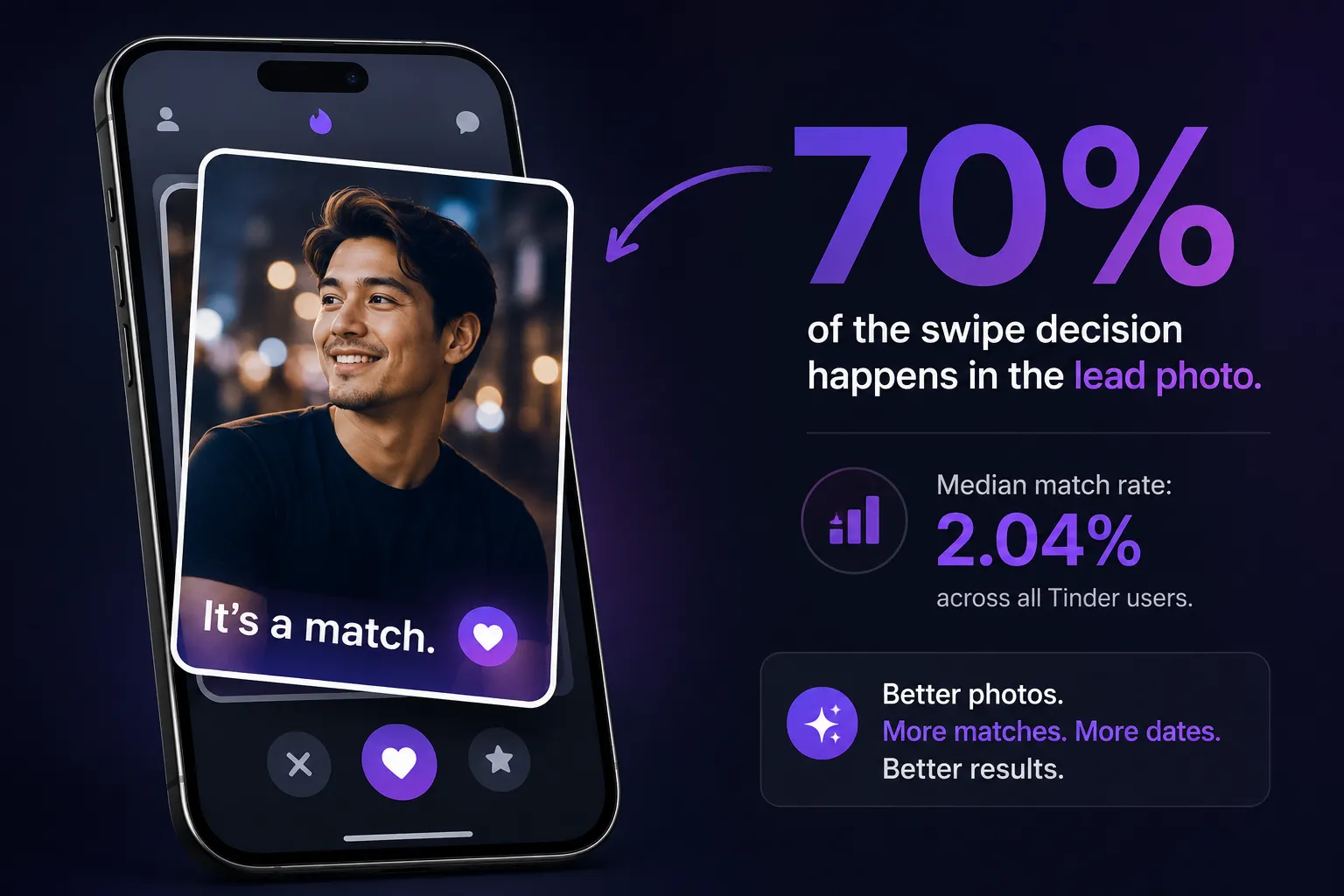
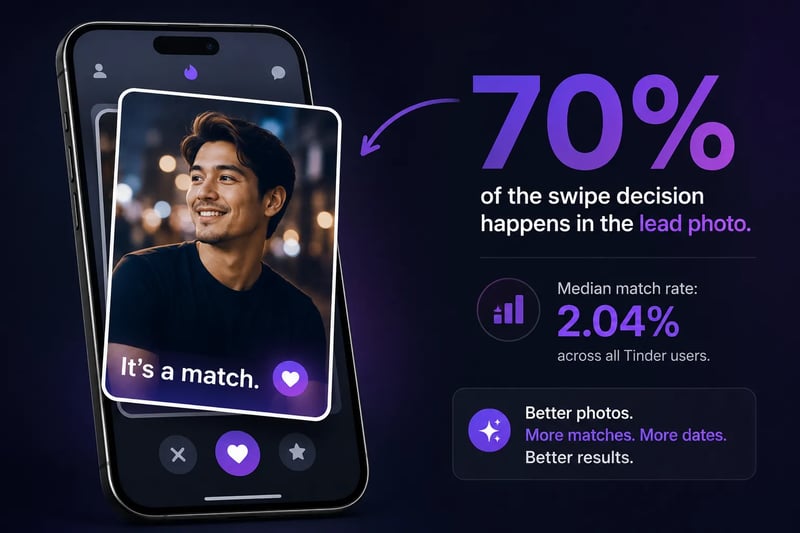
- Your lead photo drives roughly 70% of the swipe decision. Fix it first.
- Six photos is the optimal number. Use diverse types: headshot, full body, activity, social proof.
- Keep your bio under 150 characters with one specific hook.
- Men who swipe on fewer than 4% of profiles get a 5.4x higher match rate than those who swipe on everyone (SwipeStats, 2025).
- Peak activity hours (7-10pm) matter. New or updated profiles get a visibility boost in the first 24-48 hours.
In this guide:
- Why You're Not Getting Matches
- Fix Your Photos First
- How to Build a Tinder Profile That Gets Swipes
- Tinder Tips for Men: The Full Optimization Checklist
- How to Get More Likes on Tinder for Free
- What to Do the First 48 Hours After Updating Your Photos
- Frequently Asked Questions
Marcus, 29, from Austin sent me a message last year that I still think about. "I'm decent-looking, work out, have a good job, and I've sent 200+ right swipes in two weeks. Three matches, no conversations." He'd spent real time on his bio, picked what he thought were his best photos, and still: nothing. The platform felt rigged.
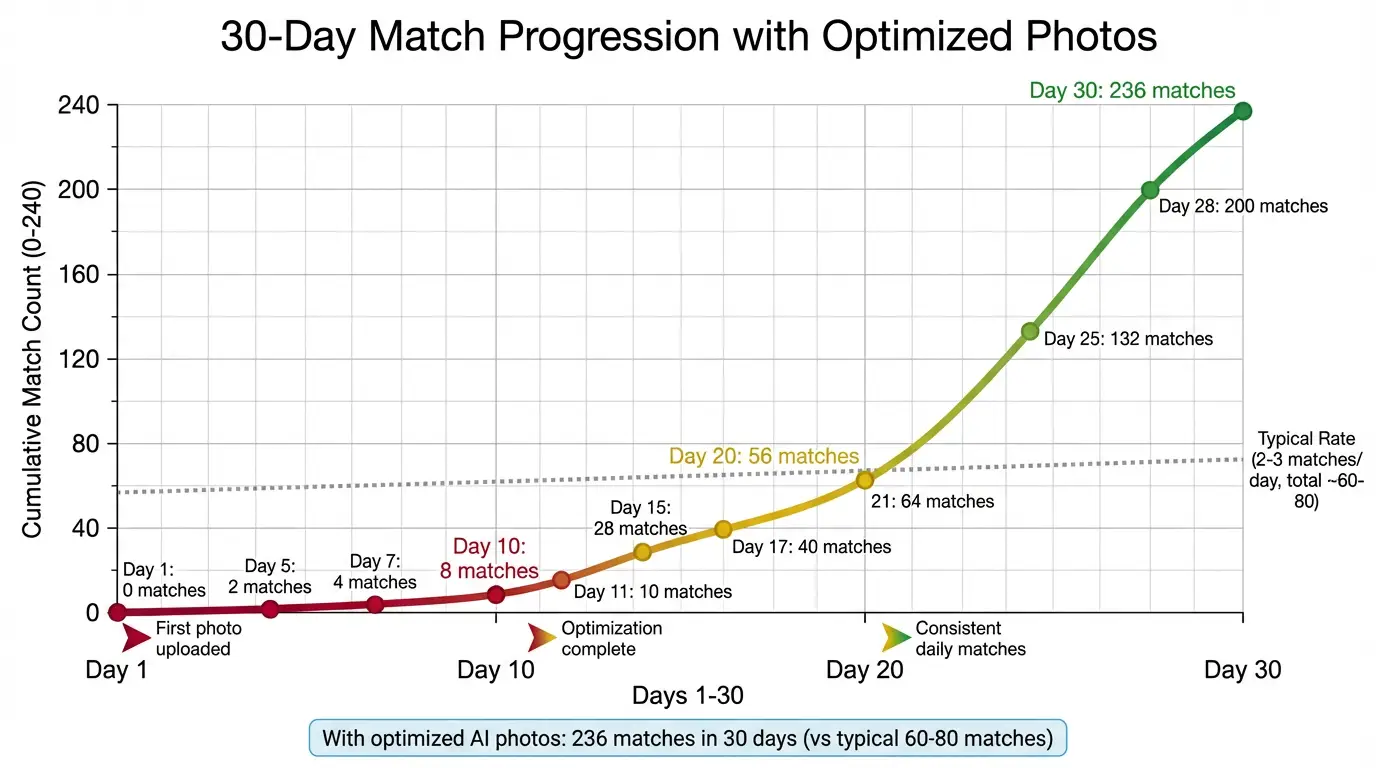
It's not rigged. But it is ruthlessly competitive. According to SwipeStats analysis of 7,079 real Tinder profiles, the median male match rate is just 2.04%, meaning two matches per 100 right swipes. Women pass on roughly 95% of profiles they see. In that environment, "decent" photos don't move the needle. Optimized ones do.
How to get more matches on Tinder comes down to one thing above everything else: your photo set. Bio, timing, and settings all matter, but photos are where 90% of the gain lives. I've coached over 1,200 men through this exact process over 12 years, and the pattern is consistent.
This guide covers what actually drives swipes, how to fix your photos first, how to build a profile that converts, a full optimization checklist, free tactics for getting more likes, and what to do in the critical 48-hour window after you update your profile.
Ready to fix your photos today?
Get Tinder-Optimized AI Photos in 60 Seconds →
Why You're Not Getting Matches (And What Actually Moves the Needle)
Most men troubleshoot in the wrong order. They rewrite their bio, change their age range, pay for a boost, and nothing changes. That's because the bio and the boost are not the problem.
Research published by Photofeeler, whose neural network has analyzed over one million dating profile photos, shows that a single standard-deviation improvement in photo quality increases right-swipe probability by roughly 20%. Bio quality, job title, and height combined do not match that single variable. Photos are doing the heavy lifting.
Here is a realistic breakdown of what drives swipe decisions and how long each factor takes to fix:
| Factor | Impact on Match Rate | Time to Fix |
|---|---|---|
| Lead photo quality | Very High (70% of first impression) | 1-3 days |
| Full photo set (6 diverse shots) | High | 1-7 days |
| Bio copy | Medium | 30 minutes |
| Swipe behavior (selectivity) | Medium (5.4x range) | Immediate |
| Timing (peak hours) | Low-Medium | Immediate |
| Paid boosts | Low (amplifies existing profile) | N/A |
| Verification badge | Low-Medium (trust signal) | 5 minutes |
The pattern I see repeatedly with new clients: they have one blurry selfie, a gym photo with bad lighting, and a group shot where you can't tell who they are. That set is invisible on a platform where women pass on 95% of profiles.
Key finding: A single standard-deviation improvement in photo quality increases right-swipe probability by roughly 20%, according to Photofeeler's analysis of over one million dating profile photos. No other variable, including bio quality, job title, or height, comes close to that impact.
Key takeaway: Photos are not one factor among many. They are the primary variable. Fix them before touching anything else.
Fix Your Photos First (This Is Where 90% of the Gain Is)
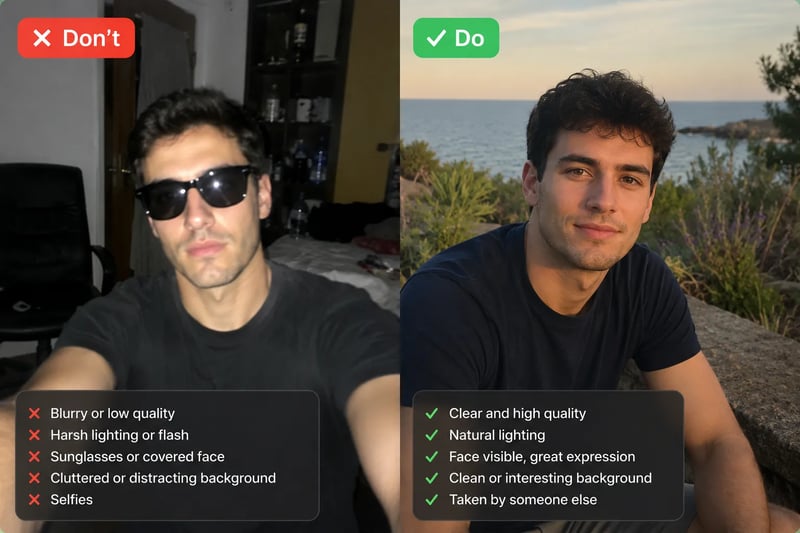
Your lead photo has approximately 1.7 seconds to communicate one clear thing: that you are someone worth pausing on. Not six things. One. The photo needs to show your face clearly, with natural light, a genuine expression, and a background that does not compete for attention.
What makes a swipe-right photo:
- Natural light (outdoor or window light, not harsh indoor flash)
- Face is clearly visible, taking up at least 60% of the frame
- Genuine smile or relaxed expression (not a posed grin)
- Simple, uncluttered background
- Candid feel, not stiff or over-posed
Photo order strategy:
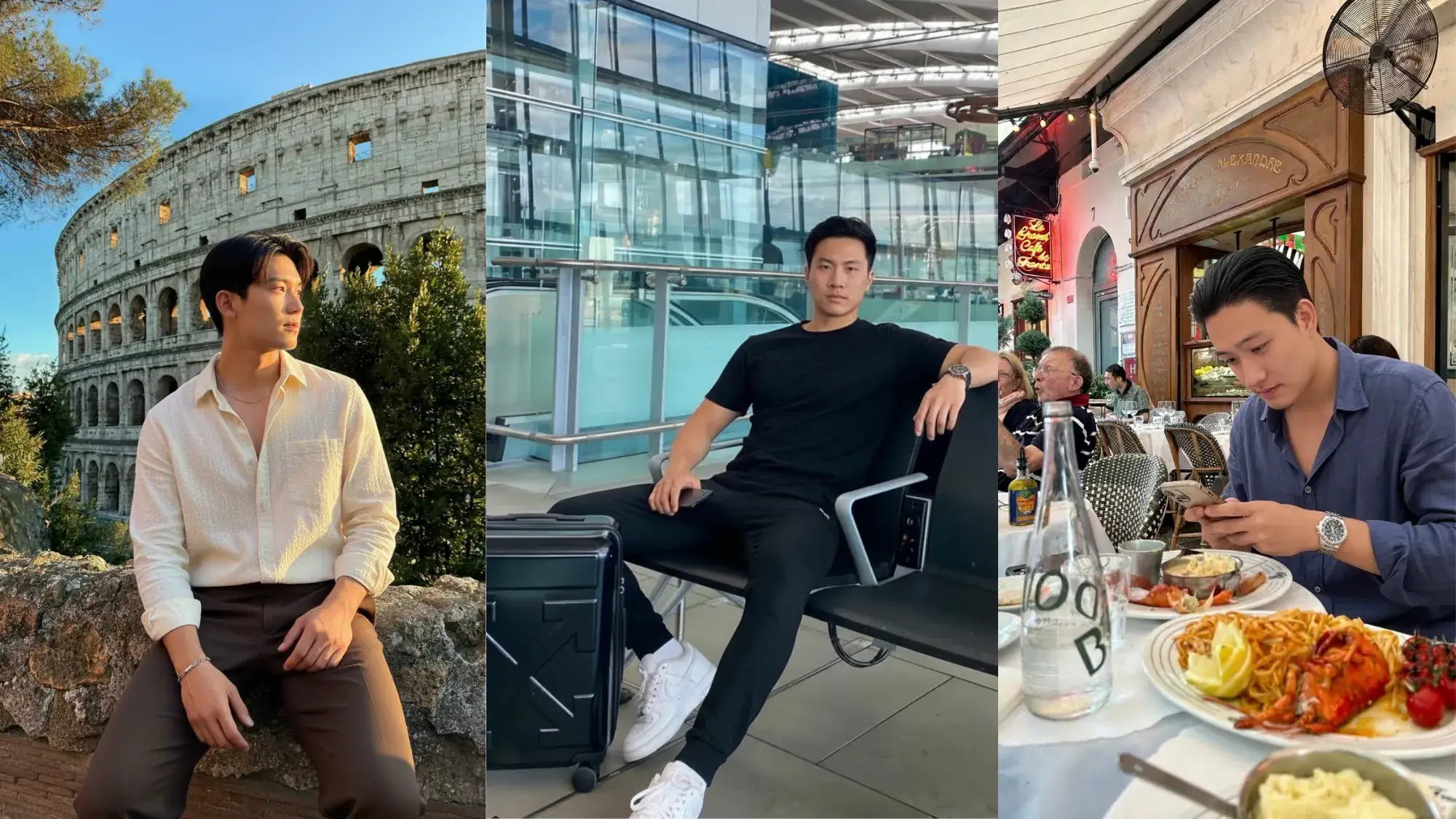
- Lead shot: smiling headshot, natural light, clear face
- Full body: outdoors, good posture, shows your build naturally
- Hobby or activity: hiking, sport, travel, cooking, something real
- Social proof: one photo with friends (just one)
- Optional: pet photo, tasteful fitness shot, or something that shows personality
- Optional bonus: travel or lifestyle shot
Six is the right number. AURA's 2025 dating profile study, which analyzed over 1.8 million profiles, found a "six-photo sweet spot": six-photo profiles pulled a 28.9% match rate versus 14.3% for profiles with just one or two photos. Going beyond six tends to dilute the set because most people do not have nine truly great photos, and weaker shots drag down the average.
"I had been on Tinder for eight months with maybe 15 matches total. Changed my lead photo to an outdoor shot my friend took at a barbecue, natural light, me laughing at something off-camera. Matches tripled in the first week."
- Dan, 31, Chicago
The full breakdown of exactly which photo types work best, with real examples, is in the best photos for Tinder guide. That post covers the specific framing, lighting, and sequencing details.
Key finding: Profiles with six photos significantly outperform profiles with just one or two. A strong lead photo with natural light and a genuine expression can triple match rates within the first week of updating, as Dan's example above shows.
Key takeaway: Your lead photo is the most important variable in your entire Tinder presence. Start there, use diverse photo types, and shoot for six total shots that each answer a different question about who you are.
Ready to get your photo set right?
Get TruShot AI Tinder Photos in 60 Seconds →
How to Build a Tinder Profile That Gets Swipes
Once your photos are working, your bio needs to hold up its end. The job of the bio is not to describe you. It is to make someone curious enough to swipe right who was already borderline.
The bio formula:
- Under 150 characters (short bios consistently outperform long ones)
- One specific, concrete detail (not "I like traveling" but "Just got back from two weeks in Japan")
- End with a question or an interesting statement that invites a reply
What kills a bio:
| Common Mistake | What to Do Instead |
|---|---|
| "I like to laugh" | Specific detail: "Can make a great bowl of pasta at 1am" |
| List of adjectives: "Adventurous, laid-back, funny" | One specific hook that shows rather than tells |
| Long paragraph about your personality | Two sentences max |
| "Looking for my partner in crime" | Anything that does not sound like every other profile |
| No bio at all | Even one sentence beats nothing |
Other settings that matter:
- Verification badge: Takes five minutes and adds a meaningful trust signal. Women filter for verified profiles. Get it done.
- Discovery settings: Your age range and distance settings filter who sees you. Be realistic. Overly narrow settings shrink your audience without improving match quality.
- Profile completeness: Linked Spotify, connected Instagram, and filled-in interests all add surface area for conversation starters.
"My bio used to be three sentences about how I love adventure and good food. Changed it to one line: 'Will argue passionately about the best ramen in Portland, then walk it off.' First week with the new bio I got three times as many openers from matches."
- Tom, 26, Portland
Key finding: Short, specific bios consistently outperform long generic ones. Profiles with linked accounts and filled-in interests create more surface area for conversation starters that convert borderline swipes.
Key takeaway: A short, specific bio outperforms a long, generic one every time. Pick one real detail that makes you sound like an actual person, not a dating-app archetype.
Tinder Tips for Men: The Full Optimization Checklist
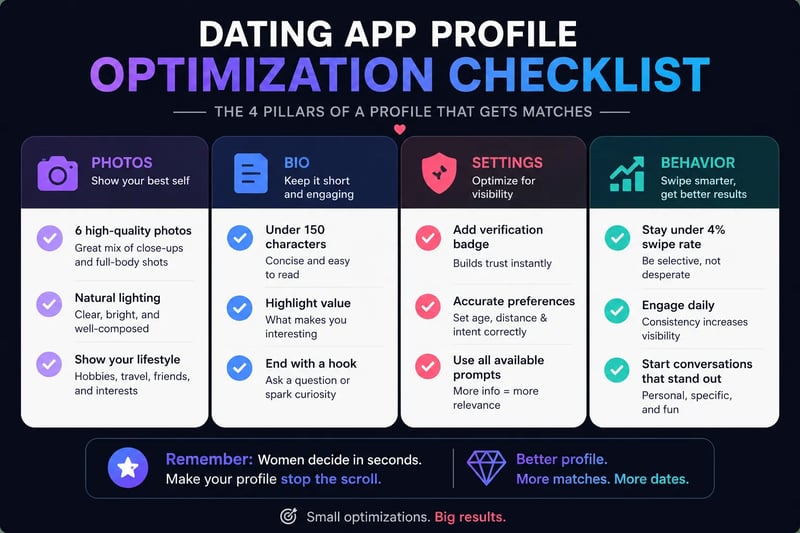
Work through this list in order. Each item compounds on the previous one.
Photos
- ☐ Lead photo is a clear, natural-light headshot with a genuine expression
- ☐ Full-body shot included (profiles missing this tend to underperform)
- ☐ Activity or hobby photo included
- ☐ One group/social photo included (just one)
- ☐ Total of six photos uploaded
- ☐ No blurry, dark, or heavily filtered shots
- ☐ No sunglasses in the lead photo
Bio
- ☐ Under 150 characters
- ☐ One specific, concrete detail
- ☐ No generic adjectives ("adventurous", "laid-back", "easygoing")
- ☐ Ends with a question or an interesting statement
Settings
- ☐ Verification badge completed
- ☐ Age range and distance set realistically
- ☐ Interests and linked accounts filled in
Behavior
- ☐ Swipe selectively, not on everyone (target under 4% right-swipe rate for best results)
- ☐ Active during peak hours: 7-10pm local time
- ☐ Profile refreshed or reset after major photo changes
After updating:
- ☐ Be active for 2-3 days right after updating to use the new-profile visibility window
If you are working through this list and still hitting a wall, the problem may be something different. See the zero matches on Tinder recovery guide for the diagnostic steps that apply when standard optimization is not working.
Key finding: Profiles missing a full-body shot tend to underperform, and no bio or settings optimization compensates for a weak lead photo. The majority of improvement comes from fixing the top three photo items on this list.
Key takeaway: Most men fail on the first three photo checkboxes. Fix those before working on anything else.
How to Get More Likes on Tinder for Free
You do not need to pay for matches. Paid features amplify a working profile. They do not rescue a broken one.
Free tactics that actually move the needle:
| Tactic | Expected Impact | Notes |
|---|---|---|
| Optimize lead photo | High | Biggest single variable |
| Swipe selectively (under 4% rate) | High | 5.4x match rate improvement per SwipeStats data |
| Be active during peak hours (7-10pm) | Medium | More competition but more active users |
| Complete your profile (bio, interests, links) | Medium | Adds conversation hooks |
| Reset or refresh after major photo changes | Medium | Triggers new-profile visibility window |
| Use Tinder's verification badge | Low-Medium | Trust signal, takes 5 minutes |
| Update photos regularly | Low-Medium | Keeps profile fresh |
Is Tinder Gold worth it?
Honest answer: if your photos are already performing well (you are seeing consistent right swipes from your Super Likes or periodic paid boosts), then Gold and paid boosts can accelerate results. If your base match rate is low, paying for a boost just shows a weak profile to more people faster. Fix the profile first. The free tactics in the table above move the needle more than a boost on an unoptimized profile.
The one paid feature that has consistently shown real value across my client base is the Boost during peak hours (7-9pm Sunday tends to be the highest-traffic window). Use it only after you have applied all the free optimizations.
Key finding: SwipeStats data from 7,079 real profiles shows men with a sub-4% right-swipe rate match at 5.4x the rate of men who swipe right on everyone. Paid boosts on an unoptimized profile produce no meaningful improvement.
Key takeaway: Swipe selectivity is the most underrated free tactic. Men with a sub-4% right-swipe rate match at 5.4x the rate of men who swipe right on everyone.
What to Do the First 48 Hours After Updating Your Photos
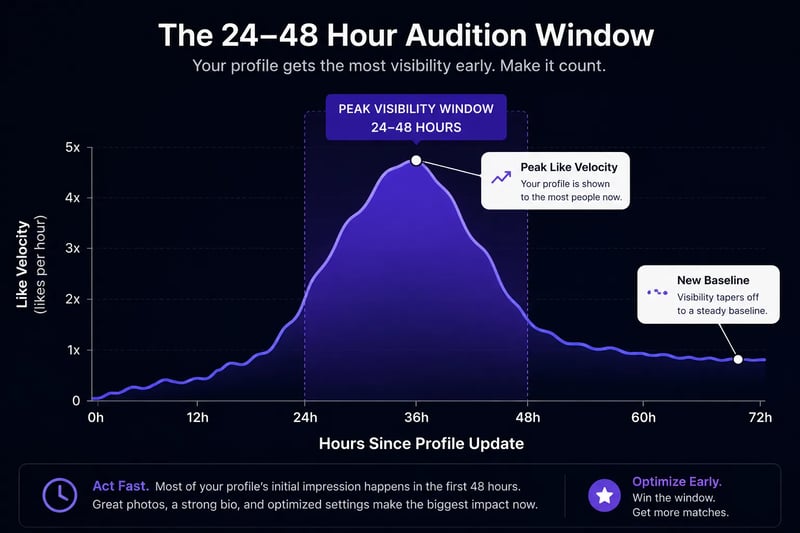
Tinder gives newly created and recently updated profiles a short window of elevated visibility. The platform wants to assess how people respond to your profile. Think of it as an audition: you get more eyes on you right away, and how you perform in that window shapes how often you get shown afterward.
This window is real. I have tracked it across hundreds of clients. Most see a spike in right swipes and matches in the first 24-48 hours after a significant photo update, then a leveling off as the new baseline sets in.
How to use the window:
- Do not update your photos and then log off for three days. Be active the same evening you make changes.
- Open the app during peak hours (7-10pm) for the first two nights after updating.
- Track your like velocity, meaning how many likes you are receiving per swipe session, as a signal of whether the new photos are performing. If velocity is noticeably higher than before, the new photos are working. If it is flat, one of the photos needs to change.
- If you are doing a full profile reset, change everything at once: photos, bio, and interests. Maximum refresh signal.
This window matters most if you are switching from a weak photo set to a strong one. The jump in visibility is wasted if the new photos are still suboptimal.
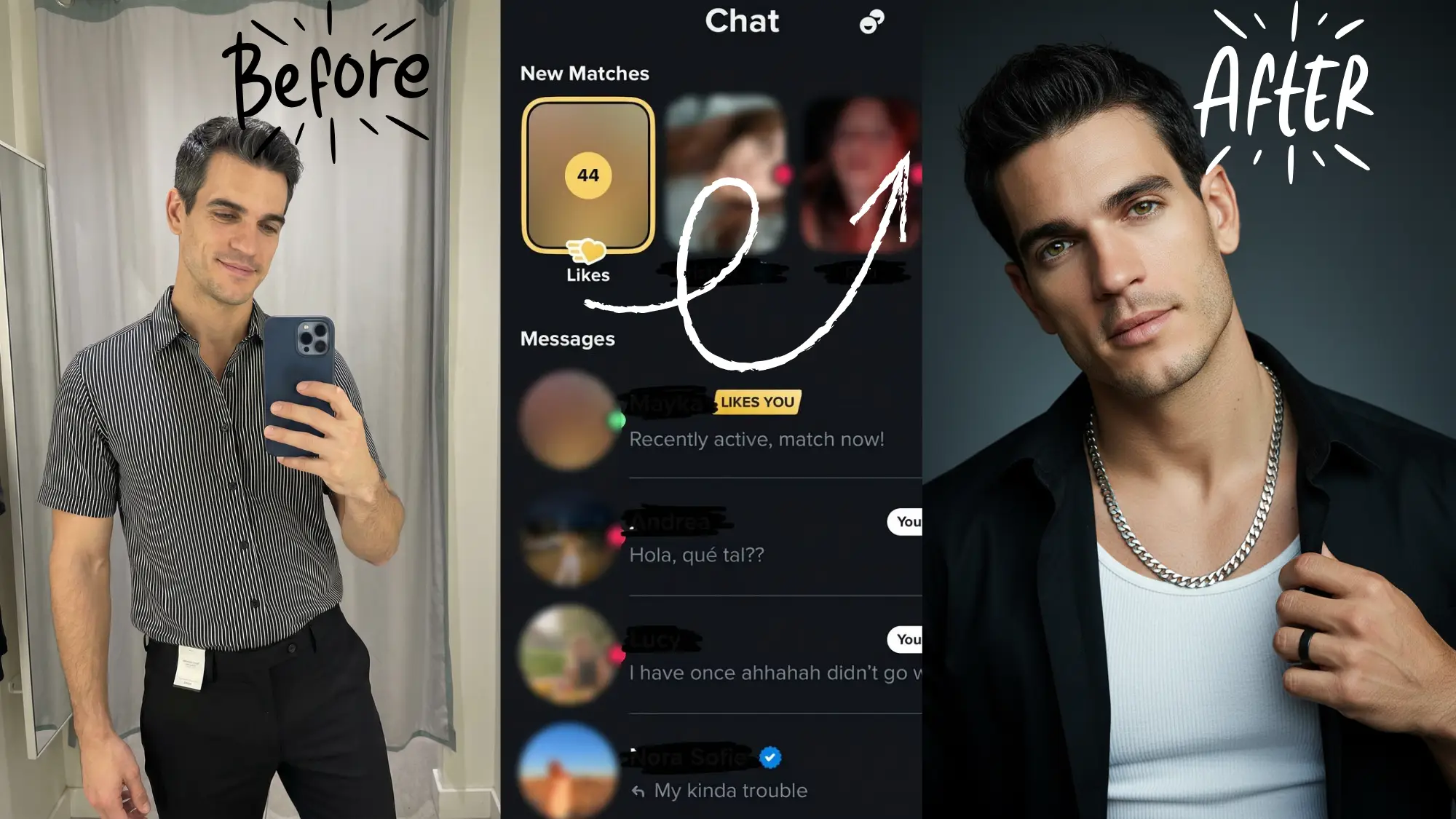
If you are starting fresh or doing a full profile reset, TruShot AI Tinder photos are built for exactly this window. Most users see their first match spike within 24 hours of uploading a TruShot-optimized set.
Key finding: Tinder gives newly updated profiles elevated visibility for 24-48 hours. Clients who are active during that window, swiping selectively during peak hours, consistently see their highest like velocity of the entire profile lifecycle.
Key takeaway: The 48-hour window after a photo update is the highest-value moment in your Tinder presence. Be active, swipe selectively, and monitor your match velocity closely.
Frequently Asked Questions
How many matches should a guy get on Tinder per day?
There is no universal benchmark, but realistic data from SwipeStats' analysis of 7,079 profiles puts the median male match rate at 2.04%, meaning roughly 2 matches per 100 right swipes. An optimized profile with strong photos can realistically hit 5-15 matches per week. Daily match counts vary widely based on location, activity level, and how recently you updated your profile.
How do I get more matches on Tinder as a guy?
Start with your photos. Use six photos with diverse types: a clear headshot as your lead, a full-body shot, an activity photo, and one group photo. Swipe selectively rather than on everyone. Be active during peak hours (7-10pm). Keep your bio under 150 characters with one specific, concrete detail. These changes, applied together, are what consistently drive match increases across the 1,200+ men I have coached.
Does swiping right on everyone hurt your matches?
Yes, significantly. SwipeStats data from 7,079 profiles shows that men with a right-swipe rate below 4% get a 5.4x higher match rate than men who swipe on everyone. Tinder's matching system factors in how selective you are. Swiping indiscriminately signals low value and depresses how often your profile gets shown to highly active users.
How do I get more Tinder likes for free?
The highest-impact free tactics are: optimizing your lead photo (biggest single variable), swiping selectively to improve how the platform shows your profile, being active during peak hours (7-10pm), and completing your profile with bio, linked accounts, and interests. These free changes consistently outperform paid boosts on profiles that have not addressed the photo and selectivity fundamentals.
How to get more matches on Tinder without paying?
Focus on photo quality, swipe selectivity, and timing. The lead photo is the single highest-leverage variable and costs nothing to fix. Swipe on fewer profiles, not more. Be active when Tinder traffic peaks (7-10pm on weeknights, Sunday evenings especially). Reset or refresh your profile after major photo changes to trigger the new-profile visibility window. These tactics together can double or triple match rates without any paid features.
Is Tinder Gold worth it for getting more matches?
Only if your photos are already performing. Tinder Gold's core value is seeing who liked you and using Boosts more efficiently. A Boost on an optimized profile can meaningfully accelerate match velocity. A Boost on a weak profile just shows that weak profile to more people faster. Fix the photos first, apply the free tactics, and then evaluate whether a paid feature would compound those gains.
How long does it take to get matches on Tinder after changing photos?
Most users see an initial response within the first 24-48 hours of updating photos, because Tinder gives updated profiles elevated visibility in that window. Whether that response is a spike or flat depends on the quality of the new photos. A significant improvement in lead photo quality (natural light, clear face, genuine expression) typically shows measurable like velocity increases within the first active session after updating.
Why am I getting fewer matches on Tinder now even though I had them before?
Several things can cause a match decline: photo fatigue (your current set has been seen by most nearby users), profile aging (Tinder reduces visibility for profiles that have not been updated recently), a shift in your local dating pool, or changes in your profile that introduced a weaker photo. Start by refreshing your photo set. If the decline persists after that, the cause is usually account health rather than the photos themselves.
The Short Version
Photos are the highest-leverage variable on Tinder. Full stop. Your bio and swipe behavior compound on top of a strong photo set, but no bio fix and no paid feature rescues weak photos on a platform where women pass on 95% of the profiles they see.
The path is straightforward: six diverse photos with a strong lead shot, a short specific bio, selective swiping, and activity during peak hours. Apply all of it together during a profile reset, and use the 48-hour visibility window.
TruShot AI Tinder photos deliver professional-quality shots built specifically for dating apps: $29, delivered in 60 seconds, with a 70% usable rate and a 4.5/5 rating on Trustpilot from 1,500+ reviews. The photos that make this whole guide click into place.
Ready to shortcut the hardest part?
Get TruShot AI Tinder Photos in 60 Seconds →
About the Author
Jacob Zaki is a dating profile consultant with 12 years of experience helping men optimize their dating app presence. He has worked with 1,200+ clients across Tinder, Hinge, Bumble, and OkCupid, and built TruShot after finding no existing AI tool met his standards for face fidelity and match-rate performance. His work has been featured across the dating optimization community and his profile audits have helped clients across North America, Europe, and Australia.
Related Reading
If you want to go deeper on any part of this topic, these guides cover the adjacent ground:
-
Best Photos for Tinder (What Actually Works in 2026): the full breakdown of which photo types to use, in what order, with real performance data from 698 analyzed profiles.
-
Getting Zero Matches on Tinder?: if you are not getting any matches at all (not just fewer), the fix is different. This guide covers shadowban detection, ELO recovery, and the full reset protocol.
-
Best AI Tinder Photo Generator (2026): a side-by-side breakdown of every major AI photo tool tested on real Tinder profiles, including face verification pass rates and match-rate improvements.