
📌 TL;DR: Hinge's own data shows likes on prompts are 47% more likely to lead to a date than likes on photos, yet most guys still answer with generic filler ("I go crazy for: pizza and good vibes"). Real research on what makes dating profiles attractive found something specific: profiles that signal wanting to know the other person read as more attractive than profiles focused on being known. The best Hinge prompts for guys use that insight, not just "be specific" advice everyone already gives. One caveat before any of it matters: prompts convert attention, they don't create it. If your photos aren't getting swiped into in the first place, nobody ever reaches the prompt to read it. Below: four prompt categories built around the research, real example answers, what to retire, and how to pick your final three.
In this guide:
- Why Your Hinge Prompts Matter More Than You Think
- The Research Nobody's Using: Why "Together, We Could" Beats "I Go Crazy For"
- The 4 Prompt Categories That Actually Work
- Hinge Prompt Answers to Retire in 2026
- How to Pick Your Final 3 Prompts
- How Your Prompts and Photos Work Together
- Hinge Prompt Feedback and Hinge Standouts, Explained
- Frequently Asked Questions
- The Bottom Line
I've rewritten Hinge prompt answers for a good chunk of the 1,200+ clients I've worked with over twelve years of dating profile consulting, and the pattern never changes. A guy sends me his profile, his photos are fine, and then I get to his prompts and it's "I go crazy for: pizza," "My simple pleasures: coffee and sunsets," "Green flags I look for: good communication." Every one of those answers could belong to any of the 40 million people on the app. That's the actual problem, not that his prompts are boring, but that they're interchangeable.
The best Hinge prompts for guys aren't the funniest ones or the most clever ones. They're the ones a match can't picture anyone else writing, and the ones that make replying easy instead of optional. That's a research-backed distinction, not a vibe, and it's below.

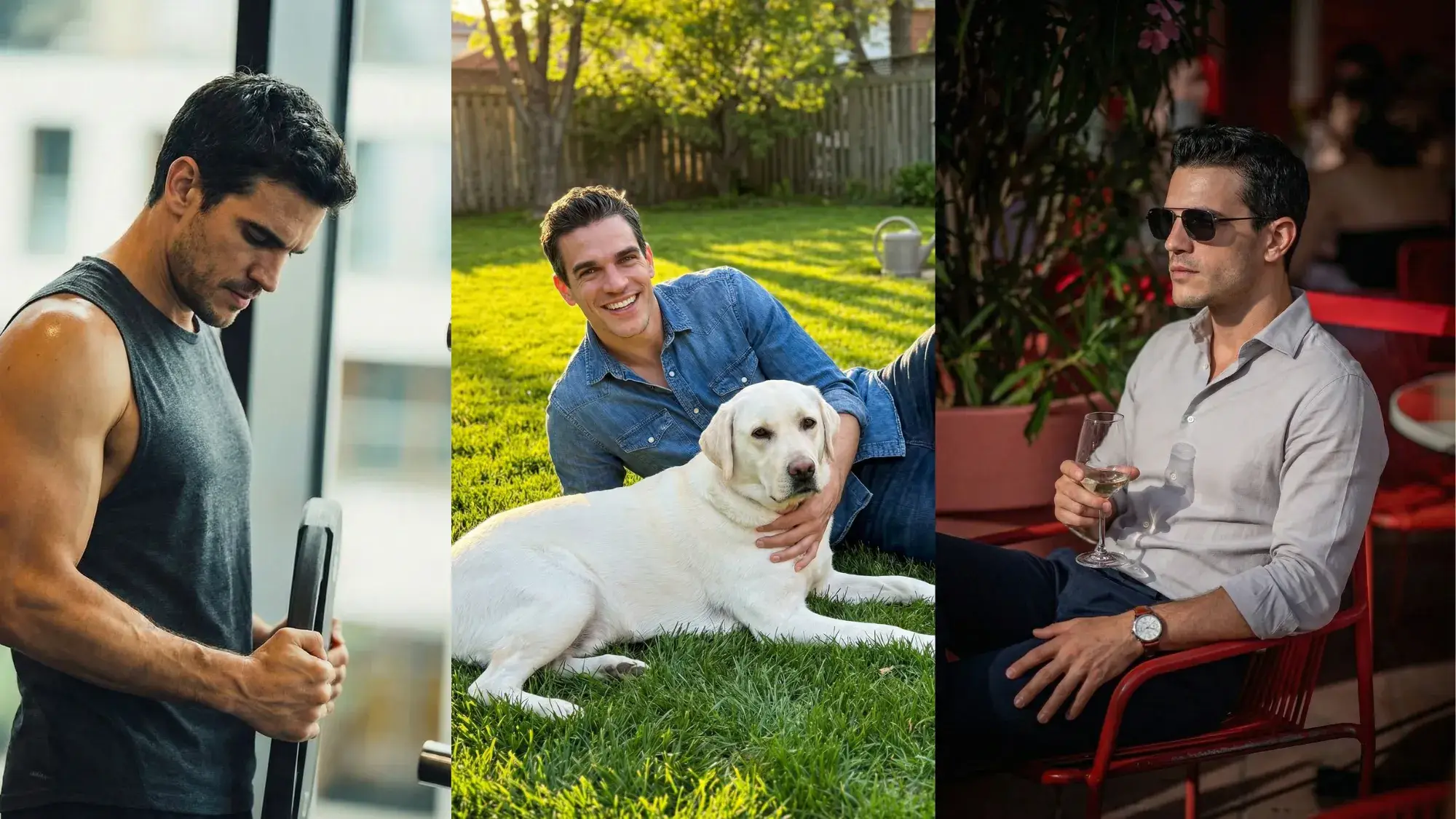
💡 One thing to check before you touch a single prompt: every category and example below assumes your photos are already doing their job. A sharp prompt on a profile with three blurry, outdated, or awkwardly-cropped photos still gets swiped past before anyone reads it, no prompt formula fixes that. If your photos are the part that needs work, TruShot's AI Hinge photos can generate a full set from selfies you already have, so you're not rewriting prompts for a profile that isn't getting opened.
Why Your Hinge Prompts Matter More Than You Think
Guys spend hours agonizing over their photos and then fill their three prompts in about ninety seconds, right before hitting publish. That ordering is backwards, according to Hinge's own numbers.
In Hinge's January 2025 newsroom post announcing Prompt Feedback, the company disclosed that in 2024, likes on text prompts were 47% more likely to lead to an actual date than likes on photos. The same announcement noted that 63% of daters on the app said they struggled with knowing what to put on their profile in the first place. Those two numbers together tell you something specific: prompts are doing more conversion work than photos, and most people are guessing at them.
That's not a knock on photos, it's the opposite. Good Hinge photos are what get you the initial like in the first place, and if that like never happens, the sharpest prompt answer in the world never gets read. Photos open the door. The prompt is what a match reads right after walking through it, deciding whether to comment or scroll past, and it's what determines whether the conversation that follows has anything to work with.
Key takeaway: Hinge's own data shows prompts convert to dates at a higher rate than photos. Treating your three prompt answers as an afterthought is the single most common mistake I see in the profiles I review.
The Research Nobody's Using: Why "Together, We Could" Beats "I Go Crazy For"
Almost every Hinge prompts article gives you the same advice: "be specific, not generic." That's true, but it's incomplete, and it doesn't explain why some specific answers still fall flat.
A 2024 study by Juliana Schroeder (UC Berkeley Haas School of Business) and Ayelet Fishbach (University of Chicago Booth School of Business), published in the Journal of Experimental Psychology and covered by UC Berkeley's own newsroom, analyzed real dating profiles from Match.com and Coffee Meets Bagel and had more than 250 independent raters score them. The researchers found that profiles emphasizing a desire to know the other person rated as significantly more attractive than profiles focused on being known, on being interesting, on broadcasting who you are. Yet the study found more than half of the profiles examined were written in "being known" mode, and only about 20% expressed genuine interest in getting to know the match.
Translate that to Hinge prompts and it explains a lot. "I go crazy for..." is a being-known prompt by default: it's about you. "Together, we could..." or "One thing I'd love to know about you is..." are invitation prompts: they point at the match, not just at you, and they hand her a specific, easy reason to respond. Both prompt types can work, but the invitation-shaped ones have research behind them that "just be specific" doesn't capture.
Key takeaway: The prompts that actually outperform aren't just the specific ones, they're the ones that signal you're curious about the other person, not just presenting yourself. That distinction is the organizing idea behind the four categories below.
The Best Hinge Prompts for Guys: 4 Categories That Actually Work
Instead of one long undifferentiated list, here are four categories built around what the research above actually found, each with real, currently active Hinge prompts and original example answers. Pick from more than one category rather than stacking three prompts from the same bucket.
| Category | What it does | Best for |
|---|---|---|
| Invitation | Signals curiosity about her, gives an easy reply hook | Your first or second prompt slot |
| Specific-detail | Broadcasts who you are, done with real specificity | Rounding out the set with personality |
| Playful/banter | Starts a light disagreement or joke | Lower-stakes matches, breaking the ice |
| Filter | Screens for real compatibility without sounding demanding | Your third slot, after the hook is set |
Invitation Prompts
These directly apply the Schroeder and Fishbach finding: they point the question at her, not at you.
- "One thing I'd love to know about you is..." → "...whether you're a person who reads the last page of a book early. I need to know what I'm working with." This is structurally an invitation prompt already; most guys waste it by writing something generic. Keep the specificity and the question feels personal instead of like a form.
- "Two truths and a lie" → "I've run a half marathon on zero training, I once talked my way out of a parking ticket by explaining the plot of a movie I hadn't finished, and I still can't do a single pull-up." Three odd, specific hooks instead of one, and the format itself invites her to respond by guessing, which does the opening-message work for her.
Specific-Detail Prompts
Self-broadcast prompts still work when the detail is concrete enough that a stranger couldn't have written it.
- "I go crazy for..." → "a corner booth, bad lighting, and a diner menu with more pages than my last relationship had red flags." Visual, a little funny, and unmistakably not a template answer.
- "My most irrational fear is..." → "that the pilot episode of a show I like will always be worse than episode three, so I keep watching well past the point of good judgment." A specific, slightly self-deprecating habit reads as more human than "spiders" ever will.
Playful and Banter Prompts
Built to start a light disagreement rather than close the conversation with a compliment.
- "Change my mind about..." → "movie theater popcorn being a legitimate breakfast food, as long as you get there before 11am." Takes a real, mildly ridiculous position worth arguing, which is the point.
- "Don't hate me if I..." → "narrate the plot out loud during a heist movie, because everyone in the room needs to know I saw the twist coming." A self-aware confession lands as funny; a defensive one ("...am too honest") reads as filler.
Filter Prompts
These quietly screen for compatibility without turning into a list of demands.
- "Green flags I look for..." → "you have a hobby you'd talk about for twenty minutes without me asking a single follow-up question." Specific and honest, without listing traits nobody could self-report against ("good communication").
- "I'll fall for you if..." → "you can recommend a restaurant with zero hesitation the second I ask where we should eat." Low-stakes, easy to picture, and it filters for decisiveness without sounding high-maintenance.
Key takeaway: Four categories, one from each covering different functions, beats three prompts that all do the same job. An invitation prompt gets the reply started, a specific or playful prompt shows personality, and a filter prompt does quiet screening.
Hinge Prompt Answers to Retire in 2026
These show up across nearly every Hinge tier-list thread and coach breakdown for the same reason: they're technically answers, but they say nothing that couldn't apply to millions of other profiles.
- ❌ "I go crazy for: pizza and dogs." Both are true for roughly everyone on the app. There's no follow-up question available.
- ❌ "Together, we could: rule the world." A joke so common it's stopped registering as a joke. It reads as a placeholder, not a personality signal.
- ❌ "My simple pleasures: coffee, sunsets, good conversation." Three nouns nobody could disagree with, which means nobody has anything to say back.
- ❌ "Green flags I look for: good communication and respect." True, unfalsifiable, and impossible to respond to with anything but "same."
- ❌ "I'm looking for: someone who makes me laugh." Nearly every profile on the app says a version of this. It filters for nothing.
Key takeaway: The common thread across every retired answer is that it could sit on a stranger's profile unchanged. If you could swap your answer onto a friend's profile and it would still make sense, it's not doing its job.
How to Pick Your Final 3 Prompts
Hinge gives you one profile and three prompt slots, so the goal isn't three good answers in isolation, it's three answers that work as a set.
- Pick one Invitation prompt. Something that hands the match an easy, specific way to respond, not a compliment-fishing setup.
- Pick one Specific-Detail or Playful prompt. Something only you could plausibly have written, ideally with a little humor.
- Pick one Filter prompt. Something that quietly screens for real compatibility, placed last so it doesn't front-load the conversation with expectations.
- Read all three together and cut anything generic. If any answer could belong to a stranger's profile, it's competing with the two you kept, not adding to them.
This is the same logic behind why one good photo isn't enough either: a single strong prompt next to two forgettable ones still reads as an average profile overall.
Key takeaway: Treat your three prompts as a set with three different jobs, not three attempts at the same joke. A profile with one invitation, one specific-detail, and one filter answer covers more ground than three prompts from the same category ever will.
How Your Prompts and Photos Work Together
Photos Are the Gate, Prompts Are the Conversion
Here's the order most guys get backwards: on Hinge, a photo is the first thing a match sees on every single card, before any prompt is even visible. If that first photo doesn't earn a look, none of the four categories above ever get read, no matter how good the answer underneath them is. A sharp prompt next to a five-year-old, badly-lit, or awkwardly-cropped photo still underperforms, because the prompt only gets evaluated once the photo has already done its job. Both have to be pulling weight, but photos are the gate and prompts are what happens after someone's already through it.
Key takeaway: No prompt formula rescues a profile whose photos aren't getting swiped into in the first place. Fix that first, then use the categories above.
Matching Your Photos to Your Prompt Style
A great photo next to "I go crazy for: pizza" also wastes the click it just earned, so once the photos are working, the two need to match. If your prompt answers lean playful and specific, like the banter examples above, your photos should back that up: candid, a little chaotic, not stiff studio shots. If your best prompt is a filter answer about wanting someone decisive, a photo of you actually making a decision (ordering confidently at a food stand, mid-adventure) reinforces it rather than contradicting it. Our breakdown of the 6 Hinge photo types that perform best covers this photo-to-prompt pairing from the photo side in more depth.
Where this gets practical fast: most guys' actual photo library doesn't have six shots that each pair cleanly with a different prompt vibe. That's the specific gap TruShot's AI Hinge photos are built to close, generating a varied set from your existing selfies so you have a candid shot for the playful prompt and a clean one for the filter prompt, instead of cropping the same three photos from your camera roll six different ways. If your photos are already solid, our AI Hinge photo generator comparison covers which tools preserve your actual face well enough to pass Hinge's Face Check, since that verification step now applies to Hinge too.
Key takeaway: Prompts and photos should tell the same story about you. A mismatch between a playful prompt and a stiff, over-posed photo set undercuts both.
Hinge Prompt Feedback and Hinge Standouts, Explained
What Is Hinge Prompt Feedback?
On January 15, 2025, Hinge launched Prompt Feedback, its first AI-powered coaching feature. It analyzes the prompt answers you've written and privately suggests one of three things: that the answer is already strong, that it could use a small refinement, or that it needs more personal detail to stand out. It's opt-in, only visible to you in your own profile settings, and it doesn't write the answer for you. It nudges rather than dictates, which fits with everything above: the tool is designed to catch exactly the kind of generic, "could apply to anyone" answers this article is telling you to avoid.
What Are Hinge Standouts?
Standouts is a separate feature: a daily-refreshing feed of profiles Hinge's algorithm identifies as both compatible with you and getting strong engagement elsewhere on the app. You can only interact with a Standout profile by sending a Rose, a limited currency (one free per week, or purchasable), which makes the interaction carry more visible weight than a normal like. Search interest in "hinge standouts" has grown noticeably through 2026, and the practical connection to prompts is direct: the specific, high-engagement kind of prompt answer covered above is also what gets a profile noticed enough to become a Standout in the first place, not a separate skill.
Key takeaway: Prompt Feedback is Hinge coaching you privately on your own answers, and Standouts is the algorithm surfacing profiles that are already doing prompts (and everything else) well. They reward the same underlying behavior: specific, non-generic answers over filler.
Frequently Asked Questions
How many prompts can you have on your Hinge profile?
Three. Hinge lets you display exactly three prompt answers on your profile at a time, chosen from a pool of over 100 available prompts, and you can edit or swap them at any time from your profile settings.
Do Hinge prompts actually matter for getting matches?
Yes. According to Hinge's own January 2025 newsroom data, likes on text prompts in 2024 were 47% more likely to lead to an actual date than likes on photos. The same announcement noted that 63% of daters said they struggled with knowing what to put in their profile.
What is Hinge Prompt Feedback?
Prompt Feedback is Hinge's first AI-powered coaching feature, launched January 15, 2025. It privately analyzes your prompt answers and suggests whether an answer is strong, needs a small refinement, or needs more personal detail. It's optional, visible only to you, and offers guidance rather than rewriting your answer for you.
What are Hinge Standouts?
Standouts is a daily-refreshing feed of profiles Hinge's algorithm identifies as compatible with you and popular on the app. You can only interact with a Standout profile by sending a Rose, a limited weekly currency, which makes the interaction carry more weight than a standard like.
What are the best Hinge prompts for guys?
The strongest Hinge prompts for guys fall into four categories: invitation prompts that ask about her rather than just describing you (like "One thing I'd love to know about you is"), specific-detail prompts with concrete, verifiable personality (like "I go crazy for"), playful prompts that start light banter (like "Change my mind about"), and filter prompts that screen for compatibility (like "Green flags I look for"). Picking one from each category, rather than three from the same bucket, covers more ground.
What Hinge prompt answers should you avoid?
Avoid answers that could belong to any profile: "I go crazy for: pizza and dogs," "Together, we could: rule the world," "My simple pleasures: coffee and sunsets," "Green flags: good communication," and "Looking for: someone who makes me laugh." All five are technically answers but give a match nothing specific to respond to.
Where can I find real examples of good Hinge prompts?
Beyond curated lists like this one, communities like the r/hingeapp subreddit regularly discuss and rank real prompt answers from actual users, which can be useful for seeing what specific, non-generic answers look like in practice, though the quality varies and it's not a substitute for writing an answer specific to your own life.
Can you change your Hinge prompts after your profile is live?
Yes. You can edit your three prompt answers as often as you'd like from your Hinge profile settings, with no limit on how frequently you swap them out.
The Bottom Line
The best Hinge prompts for guys aren't the funniest ones in a recycled list, they're the ones built around what actually gets replies: specificity, yes, but more precisely, a genuine signal that you're curious about the person reading your profile, not just presenting yourself to them. Hinge's own data backs the "prompts matter more than you think" half of that. A 2024 peer-reviewed study backs the "curiosity beats broadcasting" half.
Pick one invitation prompt, one specific or playful prompt, and one filter prompt. Cut anything that could sit unchanged on a stranger's profile. But do that work in the right order: if your photos are outdated, poorly lit, or just not getting swiped into, rewriting your prompts is optimizing a part of the profile nobody's reaching. Fix the photos first, then make sure your prompts are telling the same story they are.
Generate AI Hinge Photos That Match Your Profile →
Trained on your own selfies, built to pass Hinge's Face Check, ready in 60 seconds.

About the Author
Jacob Zaki is a dating profile consultant with 12 years of experience helping men optimize their dating app presence. He has worked with 1,200+ clients across Tinder, Hinge, Bumble, and OkCupid, and built TruShot after finding no existing AI tool met his standards for face fidelity and match-rate performance. His work has been featured across the dating optimization community and his profile audits have helped clients across North America, Europe, and Australia.
Related Reading
- Best Hinge Profile Pictures: 6 Types That Get Matches: the photo side of this pairing, including which 6 photo types actually perform and how to match them to your prompt answers.
- No Matches on Hinge? Here's Why: if prompts and photos both look solid but matches still aren't coming, this covers the other 5 reasons Hinge profiles stall out.
- Best AI Hinge Photo Generator: Tested and Ranked: which AI photo tools actually pass Hinge's Face Check, for when your photo set needs the same rebuild your prompts just got.